What Size Round Brush Do I Need? A Practical Guide to Better Blow-Drying
You buy a round brush hoping for a smooth, bouncy blow-dry. Instead, you find yourself juggling a hairdryer, chasing escaping sections and wondering how your hairdresser makes it look so easy.
Part of the difference is practice. But the brush itself deserves some attention.
A brush that works beautifully on long layers might be awkward on a chin-length bob. The brush you use for a sweeping fringe may also be unsuitable for creating a gentle bend through longer hair.
Choosing the right round brush starts with two questions: how long is the hair you want to style, and what shape do you want to create?
Here is how to narrow down the options, understand the measurements and make your next blow-dry more manageable.
What does a round brush actually do?
A round brush helps you guide hair into a curved shape while blow-drying. Depending on the brush, your haircut and your technique, you can use it to lift the roots, curve the ends or create movement through the lengths.
It also gives you control over individual sections. Instead of drying your hair in every direction and arranging it afterwards, you work towards a particular finish as you dry.
However, a round brush is not necessarily the tool you need for every hairstyle.
If you want to preserve your natural curl pattern, your usual curl-styling method may suit you better. If you simply want to detangle your hair, choose a tool designed for that task.
Think of a round brush as a shaping tool within your routine.
Why brush size matters
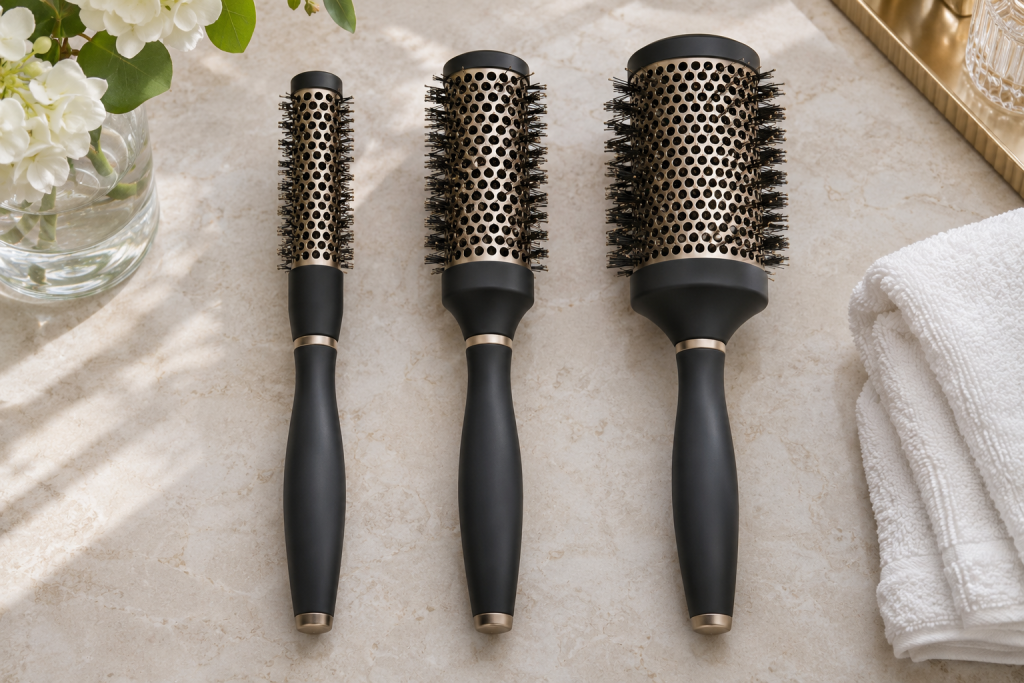
The diameter of the barrel affects how easily you can position the brush beneath a section and guide the hair around it.
Broadly, smaller barrels suit shorter sections and more pronounced shaping, while larger barrels are commonly used for longer hair and broader movement. For example, ghd’s range progresses from a 25 mm barrel for shorter styles through to a 55 mm barrel for long and extra-long hair. These are examples within one manufacturer’s range, rather than universal sizing rules.
The practical question is whether your hair can follow the curve of the brush comfortably.
If a brush is too large for the section, you may struggle to catch the ends. If it feels awkwardly small, you may find yourself doing more winding and unwinding than you intended.
Choose for the section you are styling, which may be much shorter than your overall hair length.
Understanding round-brush measurements
Brush measurements can be confusing because retailers do not always describe them in the same way.
A listed diameter may refer to the central barrel, while another listing may describe the full width, including the bristles. Check the product description or measurement diagram before comparing two brushes.
Also avoid assuming that “small”, “medium” and “large” mean the same thing across different brands.
Use this as a shopping framework:
| What you want to style | What to look for |
|---|---|
| Short sections or a short fringe | A compact barrel that fits beneath the hair |
| A bob or shorter layers | A manageable small-to-medium brush |
| Shoulder-length hair | A medium brush suited to your desired shape |
| Long layers and broad movement | A larger brush that you can control comfortably |
| Short front pieces with long hair | Consider a separate, smaller brush for the front |
Measurements help you shortlist. Your haircut and the way the brush handles should decide the final choice.
Choosing a brush for short hair
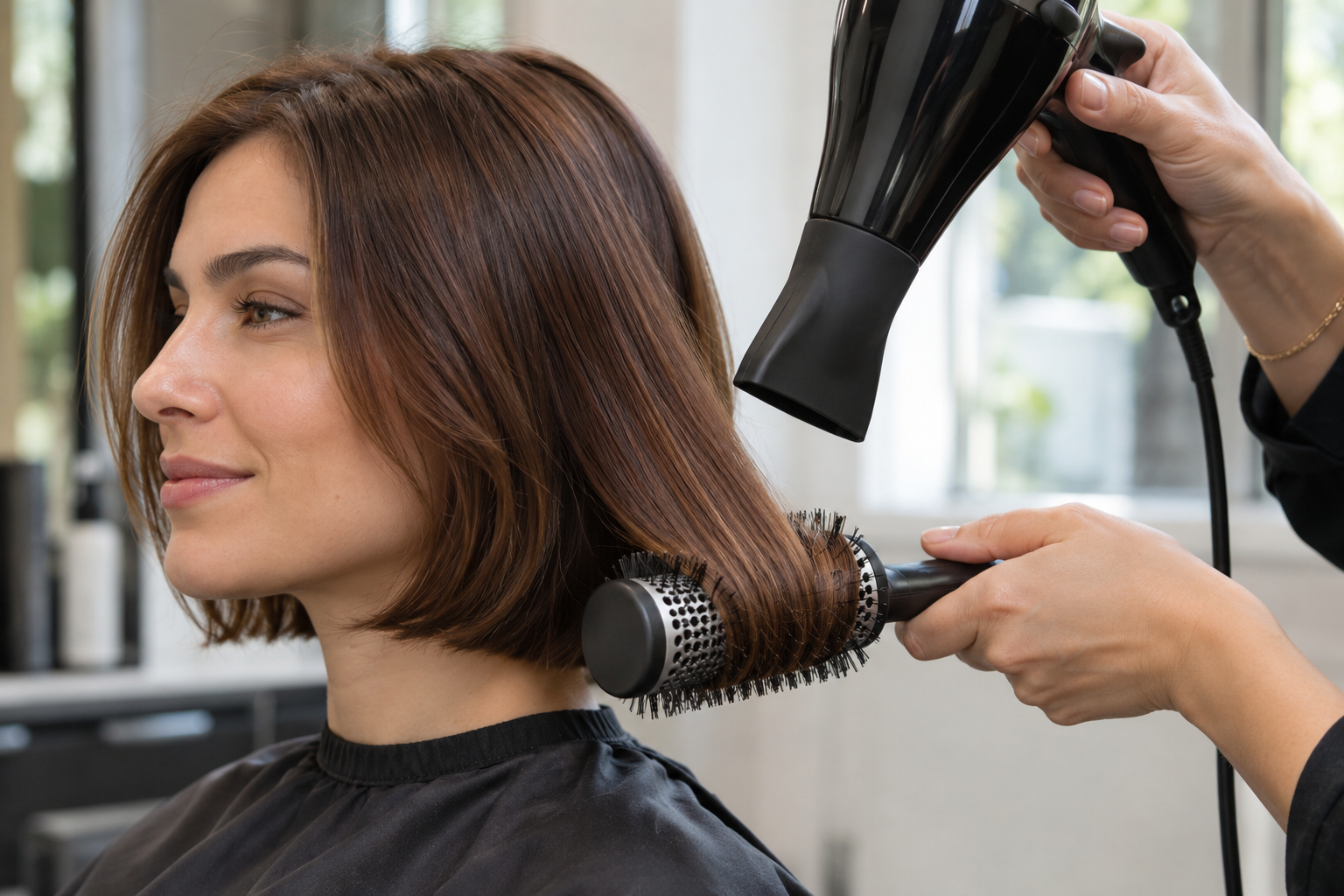
With short hair, access matters. You need enough space to place the brush under a section without scraping your scalp or losing the ends.
Look closely at your shortest layers. These are often the sections that determine whether a brush will be useful.
For a pixie cut or a closely cropped style, a conventional round brush may feel cumbersome. Ask your hairdresser to demonstrate a suitable brush on your actual haircut before buying.
For a short bob, consider where you want the shape: lift at the crown, a slight turn under at the ends or movement around your face.
You may only need to round-brush those areas. There is no requirement to work through every section if your hair already sits well elsewhere.
Choosing a brush for shoulder-length hair
Shoulder-length hair can involve several competing lengths: a longer back, shorter face-framing pieces and perhaps a fringe.
Choose your main brush around the job you do most often.
If you usually want gently curved ends, look for a brush that lets you guide those ends without excessive wrapping. If your main concern is controlling shorter front sections, check that the barrel fits those pieces.
A medium brush is a reasonable category to explore, but avoid buying solely because the packaging says “medium”.
Watch a demonstration involving a similar haircut. Notice how the brush is positioned and how much hair is used in each section.
You are looking for a method that seems manageable in your own bathroom.
Choosing a brush for long hair
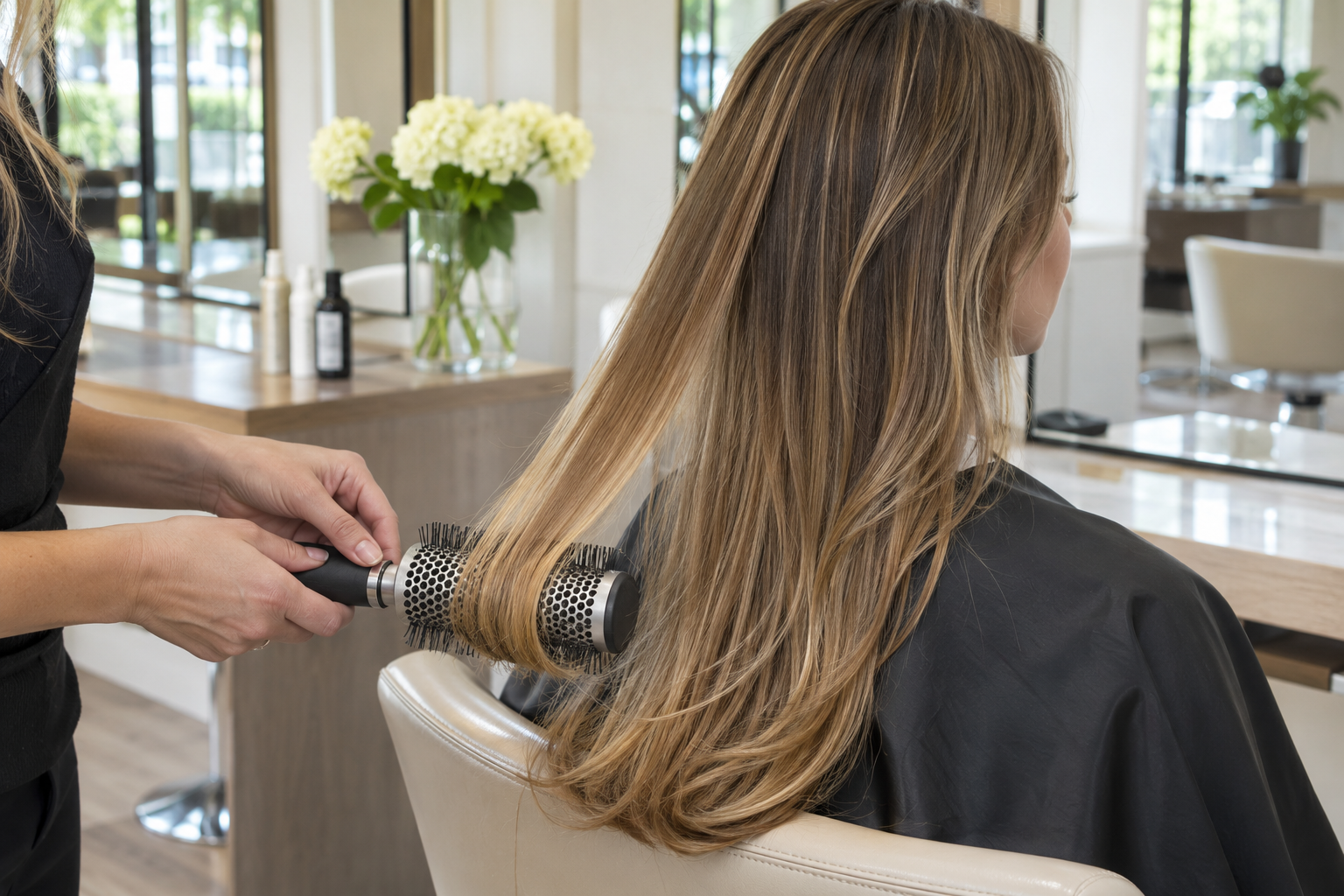
Long hair adds another consideration: how easily you can release it.
A large brush may suit a broad, flowing finish, but it still needs to feel comfortable in your hand. Check the handle, balance and weight before committing.
You should also be able to reach the back of your head without adopting an elaborate exercise pose.
When practising, work on a modest section near the front where you can see what you are doing. Learn how to guide the hair over the brush and release it smoothly before tackling harder-to-reach areas.
Avoid winding a long section repeatedly around the barrel. Follow a suitable demonstration and keep the movement controlled.
If you want defined curls throughout very long hair, consider whether a dedicated curling method would better match your goal.
What about fringes and face-framing layers?
Your fringe deserves its own assessment.
A brush that suits the back of your hair may be too large to catch a short fringe, while a very small brush may create more curve than you want.
Start by identifying the finish: a soft sweep, rounded fullness or a subtle bend.
Then ask your stylist to show you the brush position and direction for that particular shape. Watch the movement at the roots as well as the ends.
Practise with the hairdryer switched off first. You can learn where to hold the brush and how to release the hair without managing heat at the same time.
A second brush can be worthwhile when it performs a clearly different job.
Look beyond barrel size
Size is only part of the buying decision. Two brushes with similar measurements may feel quite different because of their bristles, handle and construction.
Read the description for the intended use. Then, where possible, assess:
- Bristle comfort: do the bristles feel scratchy against your skin?
- Grip: can you hold the handle securely without squeezing hard?
- Weight: would it remain comfortable during your usual styling session?
- Construction: are there rough joins or gaps where hair might catch?
- Cleaning access: can you remove trapped hair without a struggle?
Be cautious about broad promises attached to words such as “professional”, “ionic” or “salon”.
Look for an explanation of the feature and decide whether it addresses a problem you actually have.
Comfort and control are useful qualities you can judge directly.
Prepare your hair before reaching for the round brush
A round brush should not have to fight through a tangle.
The American Academy of Dermatology recommends gentle detangling with a wide-tooth comb, beginning at the ends and working upwards. Its advice also distinguishes between hair types: thick, curly hair may be combed while conditioner is still in, while straight hair should be allowed to dry a little before combing.
Follow a preparation routine suited to your hair and use your round brush once the section is manageable.
Keep your first attempts simple. Clip the rest of your hair out of the way and work where you can clearly see.
If you are pulling hard just to move the brush, pause and reassess the section.
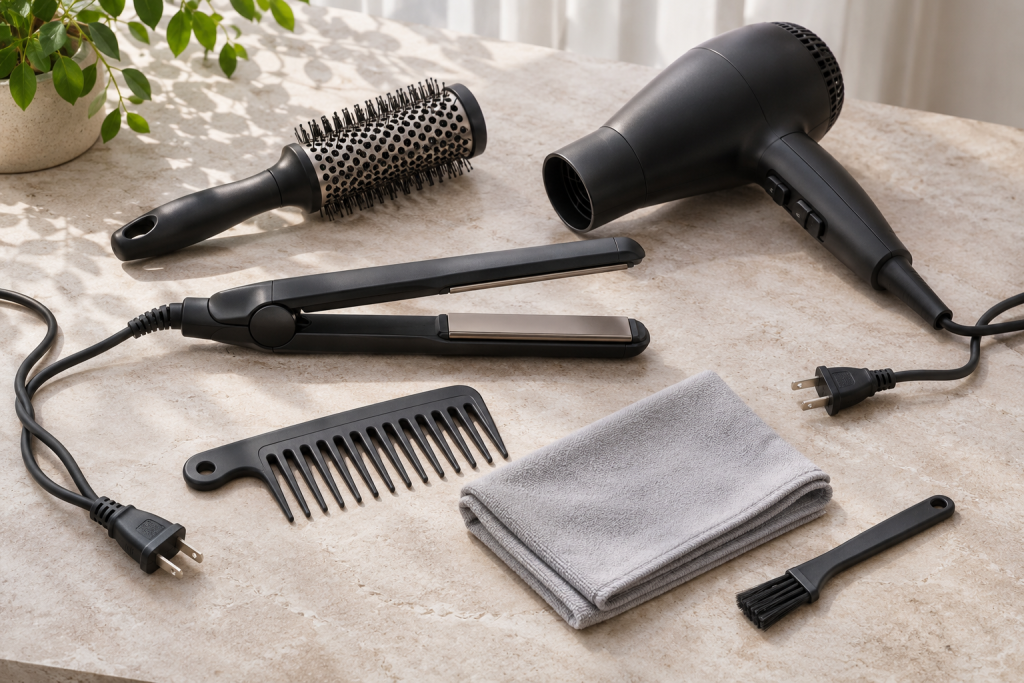
Make the hairdryer easier to manage
Trying to learn a new brush technique with the dryer already running can feel chaotic.
Before switching it on, practise holding both tools. Work out which hand feels more comfortable controlling the brush and where you can safely put the dryer down.
Keep the cord clear of your arms and give yourself enough space around the mirror.
Follow your dryer’s instructions for attachments, distance and operation. Avoid resting the nozzle against your hair or brush.
The American Academy of Dermatology advises using low or medium heat, applying suitable heat protection and limiting heat styling. A different brush does not remove the need for those precautions.
Aim for a calm, repeatable movement before trying to increase your speed.
A straightforward way to practise
Choose one small area to work on rather than attempting a complete salon-style blow-dry immediately.
Try this sequence:
- Prepare and gently detangle your hair.
- Apply heat protection according to its directions.
- Separate a manageable section.
- Place the brush beneath it without pulling.
- Practise guiding and releasing the section with the dryer off.
- Add the dryer once the movement feels comfortable.
- Stop and assess the result before repeating.
Your first goal might simply be curving the ends of two front sections.
Once that feels familiar, add another area. This gives you a chance to learn what the brush does without making your entire morning depend on a new technique.
Why does my round brush keep getting stuck?
If your brush repeatedly catches, stop and look for a pattern.
Does it happen only at the back? Are loose strands joining the section? Are you winding more hair around the barrel than you can release comfortably?
Try a smaller working section, secure the surrounding hair and simplify the movement.
If the brush becomes tangled, switch off the dryer and put it down safely. Support the hair near the scalp and gently loosen strands rather than pulling the brush through.
Ask for help if you cannot see or comfortably reach the tangle.
Repeated snagging is a reason to review the tool and technique. A brush that constantly catches your hair is making the job unnecessarily difficult.
Do you need a round brush or a hot air brush?
These tools can look similar, but they involve different ways of working.
A conventional round brush is used alongside a separate dryer. A hot air brush supplies airflow through the tool itself. Some heated brushes use a hot surface and are intended for dry hair, so check the exact product description.
Think about what you find difficult.
If coordinating two tools is the main obstacle, a suitable hot air brush may be worth exploring. If you like controlling the dryer separately or want to swap between brushes, a conventional setup may appeal.
Check the intended hair length, starting dampness and instructions before purchasing.
Choose around your routine, storage space and comfort with the tool.
Buy for the hairstyle you actually wear
Before buying, write a one-sentence description of what you want: “I want to curve the ends of my bob,” or “I want to shape my fringe and smooth my longer layers.”
That gives you something concrete to compare against product descriptions.
You may discover that one brush covers your needs. You may need a second size for shorter sections. You may also decide that your current brush is suitable and that a brief demonstration would help more than a replacement.
Take the brush to your next haircut and ask your stylist to show you how to use it on your hair.
A few minutes watching the right movement can make the next attempt at home much less of a guessing game.